An investigation into the ongoing trademark dispute between Cisco and Apple over the name "iPhone" appears to show that Cisco does not own the mark as claimed in their recent lawsuit. This is based on publicly available information from the US Patent and Trademark office, as well as public reviews of Cisco products over the past year. The trademark was apparently abandoned in late 2005/early 2006 because Cisco was not using it.
Showing posts with label Apple. Show all posts
Showing posts with label Apple. Show all posts
Monday, September 17, 2007

Monday, August 13, 2007
Call for Apple to go even greener
Greenpeace has given a cautious welcome to Apple's ambitions to be more environmentally friendly.
In a statement Steve Jobs said the company would stop using toxic and hazardous chemicals in manufacturing.
Greenpeace praised Apple for its decision to phase out the most harmful chemicals but said the electronics giant could do more.
The group wants Apple to improve its recycling policy and stop dumping old products in other parts of the world.
Gadget dump
In the statement Apple explained what it had already done to clean up its manufacturing processes and laid out how it was planning to make them greener.
Mr Jobs said in the statement that Apple's policy of not talking about its future plans had led to misconceptions about its green credentials.
"It is certainly clear that we have failed to communicate the things that we are doing well," wrote Mr Jobs.
Apple's future plans include removing arsenic in displays by the end of 2008. By the same date it will stop using polyvinyl chloride (PVC) and brominated flame retardants (BFRs).
Both PVC and BFRs are considered hazardous because they do not break down when disposed of and can accumulate in body tissue and cause a variety of health problems.
It also said it would start using LED backlighting for displays instead of mercury "when technically and economically feasible".
The statement of Apple's green credentials comes in the wake of criticism by environmental groups. In early April Greenpeace put Apple bottom of its rankings of green electronics firms.
The company's headquarters and conferences have been picketed by banner-waving activists calling on Apple to be greener.
In its own statement Greenpeace said Apple's announcement was "something we've all been waiting for" and it praised the decision to stop use of PVC and BFRs before other computer makers.
But Greenpeace said Apple still had ground to make up on its recycling policy.
The green group pointed out that Apple's pledge not to dump returned gadgets and computers in Asia and India only applied to US customers. It called on Apple to offer a global takeback and recycling service.
It said it wanted to see an Apple that was "green to the core".
Apple Technology News by BBC News
In a statement Steve Jobs said the company would stop using toxic and hazardous chemicals in manufacturing.
Greenpeace praised Apple for its decision to phase out the most harmful chemicals but said the electronics giant could do more.
The group wants Apple to improve its recycling policy and stop dumping old products in other parts of the world.
Gadget dump
In the statement Apple explained what it had already done to clean up its manufacturing processes and laid out how it was planning to make them greener.
Mr Jobs said in the statement that Apple's policy of not talking about its future plans had led to misconceptions about its green credentials.
"It is certainly clear that we have failed to communicate the things that we are doing well," wrote Mr Jobs.
Apple's future plans include removing arsenic in displays by the end of 2008. By the same date it will stop using polyvinyl chloride (PVC) and brominated flame retardants (BFRs).
Both PVC and BFRs are considered hazardous because they do not break down when disposed of and can accumulate in body tissue and cause a variety of health problems.
It also said it would start using LED backlighting for displays instead of mercury "when technically and economically feasible".
The statement of Apple's green credentials comes in the wake of criticism by environmental groups. In early April Greenpeace put Apple bottom of its rankings of green electronics firms.
The company's headquarters and conferences have been picketed by banner-waving activists calling on Apple to be greener.
In its own statement Greenpeace said Apple's announcement was "something we've all been waiting for" and it praised the decision to stop use of PVC and BFRs before other computer makers.
But Greenpeace said Apple still had ground to make up on its recycling policy.
The green group pointed out that Apple's pledge not to dump returned gadgets and computers in Asia and India only applied to US customers. It called on Apple to offer a global takeback and recycling service.
It said it wanted to see an Apple that was "green to the core".
Apple Technology News by BBC News
Universal 'to revise iTunes deal'
Universal Music Group is reported not to be renewing its annual contract to sell its music through Apple's iTunes.
The New York Times quoted unnamed executives as saying that Universal had decided to have monthly deals instead.
That would allow Universal to remove songs by some or all of its artists quickly if there are disagreements on terms and pricing in the future.
But the San Francisco Chronicle carried a denial from Apple, which said that talks were still continuing.
"We are still negotiating with Universal," the newspaper quoted an Apple spokesman as saying.
"Their music is still on iTunes and their not re-signing is just not true," he added.
Flat charges
There have been disagreements between Apple and record labels in the past about the pricing and protection of the songs on iTunes.
Apple has stuck to a flat charge of 99 cents per song in the US since iTunes was launched four years ago.
But many of the labels are understood to want to be able to charge more for popular songs and less for songs that they are trying to promote.
There have also been objections to the copy-protection that iTunes uses, which means that iTunes downloads cannot be played on MP3 players other than Apple's iPod.
In February, Apple boss Steve Jobs called on labels to allow iTunes to remove the copy-protection. EMI has since begun to sell "premium" versions of its tracks through iTunes without copy protection.
But some labels have refused to have the protection removed and say that Apple should instead license its technology so that its copy-protected songs can be played on other devices.
Shares fall
Both Apple and Universal have much at stake if their relationship deteriorates.
If Universal pulls its catalogue from iTunes then the store would lose access to record labels that account for one out of every three new releases sold in the US, according to Nielsen SoundScan.
On the other hand, iTunes is by far the most popular download store, with a 70% market share, according to the NPD Group.
Reports of a dispute hit Apple shares on Monday - they closed down 78 cents at $121.26 on Nasdaq, although that was also linked to some disappointment about the first weekend's sales of its new iPhone.
iTunes Technology New by BBC News
The New York Times quoted unnamed executives as saying that Universal had decided to have monthly deals instead.
That would allow Universal to remove songs by some or all of its artists quickly if there are disagreements on terms and pricing in the future.
But the San Francisco Chronicle carried a denial from Apple, which said that talks were still continuing.
"We are still negotiating with Universal," the newspaper quoted an Apple spokesman as saying.
"Their music is still on iTunes and their not re-signing is just not true," he added.
Flat charges
There have been disagreements between Apple and record labels in the past about the pricing and protection of the songs on iTunes.
Apple has stuck to a flat charge of 99 cents per song in the US since iTunes was launched four years ago.
But many of the labels are understood to want to be able to charge more for popular songs and less for songs that they are trying to promote.
There have also been objections to the copy-protection that iTunes uses, which means that iTunes downloads cannot be played on MP3 players other than Apple's iPod.
In February, Apple boss Steve Jobs called on labels to allow iTunes to remove the copy-protection. EMI has since begun to sell "premium" versions of its tracks through iTunes without copy protection.
But some labels have refused to have the protection removed and say that Apple should instead license its technology so that its copy-protected songs can be played on other devices.
Shares fall
Both Apple and Universal have much at stake if their relationship deteriorates.
If Universal pulls its catalogue from iTunes then the store would lose access to record labels that account for one out of every three new releases sold in the US, according to Nielsen SoundScan.
On the other hand, iTunes is by far the most popular download store, with a 70% market share, according to the NPD Group.
Reports of a dispute hit Apple shares on Monday - they closed down 78 cents at $121.26 on Nasdaq, although that was also linked to some disappointment about the first weekend's sales of its new iPhone.
iTunes Technology New by BBC News
Saturday, August 11, 2007
Apple Inc:iPhone
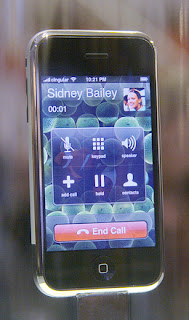
Screen:3.5 in, 320x480 px at 160 ppi
Memory:4 GB, 8 GB, internal
Networks:2.75G GSM (850/900/1800/1900), Data Download Speed - GPRS/EDGE (Up to 220 Kbps)
Connectivity:Computer via 30-pin iPod dock connector, Wi-Fi, Bluetooth
Physical size:115×61×11.6 mm (4.5×2.4×0.46 in)
Weight:135 grams (4.8 ounces)
The iPhone is a smartphone and multimedia player device announced by Apple Inc. CEO Steve Jobs during the keynote address at the Macworld Conference & Expo on January 9, 2007. The iPhone will support push IMAP from Yahoo!, mobile telephony, text messaging, web browsing, and other wireless information services.
The iPhone, unlike most smartphones, will not include a built-in keyboard or keypad; input is accomplished via a combination of technologies, including a touchscreen with software virtual keyboard and buttons. Apple has confirmed an optimized but limited version of the OS X operating system will run on the iPhone, but further distinction between the operating system (OS X) running on Macs and iPhones has not been officially explained. Third party applications are currently limited to a "controlled environment".
The iPhone has a scheduled release date of June 2007, pending Federal Communications Commission approval, and will be available from the Apple Store and via Cingular. iPhone has a planned launch price of US$499 for the 4 GB model and $599 for the 8 GB model, based on a two year service contract. The iPhone is a quad-band GSM phone, though Jobs mentioned in his keynote that Apple has a "plan to make 3G phones" in the future. Apple has filed over 200 patents related to the technology behind the iPhone.
Apple's choice of the name has resulted in some controversy as Cisco Systems has asserted that they own the trademark to the name "iPhone". Cisco sells a line of Voice over IP telephones under their Linksys brand.
From Wikipedia, the free encyclopedia
Apple TV Could Take Living Room by Storm
With 110 million iTunes users, Apple TV already has a foot in the living room door. Apple has also taken care to stay in line with its emphasis on simplicity in designing the device. This could add up to a big start for the soon-to-be-released set-top player, of which the company is expected to sell 4 million in 2008.
Apple TV hasn't shipped yet, but Piper Jaffray analyst Gene Munster thinks the home theater box is already poised to steamroll over Microsoft's (Nasdaq: MSFT) Media Center. He commented, "We believe iTunes is a Trojan horse media center, which will give Apple (Nasdaq: AAPL) a significant early lead in the digital living room."
Munster estimates there are about 110 million iTunes users -- the key market for Apple TV. In comparison, there are only about 12 million Windows Media Center users, even though the software is pre-installed on about 23 million PCs. Based on those figures, Apple already has a 10x head start over Microsoft in gaining control over digital home entertainment.
"With a wireless media streaming device, simplicity is key, and Apple carried its focus on simplicity to this product," he said. "During our tests of Apple TV at Macworld we found it very easy to use with a simple remote and intuitive navigation."
That ease of use will likely translate into sales for Apple. Wall Street is estimating Apple will sell 4 million Apple TV units in calendar 2008, generating about US$1.2 billion in revenue.
Munster is rating Apple as "Outperform" with a target price at $124. Apple is currently trading in the pre-market at $89.40, down 0.17 cents (0.19 percent).
Apple TV Technology News by technewsworld
EU price probe into Apple iTunes
The EU has launched an inquiry into what Apple's online music store iTunes charges users across Europe, accusing it of restricting customer choice.
Brussels believes agreements between Apple and record companies violate EU laws by preventing users in one country buying music from a site elsewhere.
The move follows a complaint by UK body Which? that British users have to pay more to download songs than others.
Apple said it wanted to offer a single European service but faced obstacles.
Different pricing
The Commission's move is unrelated to an agreement, announced on Monday, between iTunes and EMI to make the latter's music available online without piracy protection.
Brussels has written to Apple and a number of unnamed record companies to notify them of their objections to the way music is sold, the first step in formal proceedings.
Media reports speculated that it had contacted each of the "big four" record companies - EMI, Sony BMG, Warner Music and Universal Music.
The Commission said Apple established customers' country of residence through their credit card details and only allowed people to buy tracks from the website for that country.
"Consumers can only buy music from the iTunes online stores in their country of residence and are therefore restricted in their choice of where to buy music," said EU competition spokesman Jonathan Todd.
Research by Which? in 2005 found that UK users paid 79p (1.16 euros) to download a song, compared with 66p (99 euro cents) in France and Germany.
Apple said it had always wanted to offer a fully pan-European service, but was restricted by the demands of its music partners.
"We were advised by the music labels and publishers that there were certain legal limits to the rights they could grant us," it said in a statement.
'Restricting competition'
The companies targeted by Brussels have two months in which to respond to the charges.
Which? welcomed the investigation, saying the benefits of the European single market should be available to music lovers in all member states.
"This investigation proves that iTunes is overcharging its UK customers, who are paying substantially more for their music," said Alena Kozakova, its principal economist.
"The announcement means that companies can no longer hide behind intellectual property rights to restrict competition for consumers."
Apple iTunes News by BBC NEWS
Call for Apple to go even greener
Greenpeace has given a cautious welcome to Apple's ambitions to be more environmentally friendly.
In a statement Steve Jobs said the company would stop using toxic and hazardous chemicals in manufacturing.
Greenpeace praised Apple for its decision to phase out the most harmful chemicals but said the electronics giant could do more.
The group wants Apple to improve its recycling policy and stop dumping old products in other parts of the world.
Gadget dump
In the statement Apple explained what it had already done to clean up its manufacturing processes and laid out how it was planning to make them greener.
Mr Jobs said in the statement that Apple's policy of not talking about its future plans had led to misconceptions about its green credentials.
"It is certainly clear that we have failed to communicate the things that we are doing well," wrote Mr Jobs.
Apple's future plans include removing arsenic in displays by the end of 2008. By the same date it will stop using polyvinyl chloride (PVC) and brominated flame retardants (BFRs).
Both PVC and BFRs are considered hazardous because they do not break down when disposed of and can accumulate in body tissue and cause a variety of health problems.
It also said it would start using LED backlighting for displays instead of mercury "when technically and economically feasible".
The statement of Apple's green credentials comes in the wake of criticism by environmental groups. In early April Greenpeace put Apple bottom of its rankings of green electronics firms.
The company's headquarters and conferences have been picketed by banner-waving activists calling on Apple to be greener.
In its own statement Greenpeace said Apple's announcement was "something we've all been waiting for" and it praised the decision to stop use of PVC and BFRs before other computer makers.
But Greenpeace said Apple still had ground to make up on its recycling policy.
The green group pointed out that Apple's pledge not to dump returned gadgets and computers in Asia and India only applied to US customers. It called on Apple to offer a global takeback and recycling service.
It said it wanted to see an Apple that was "green to the core".
Apple Technology News by BBC News
Universal 'to revise iTunes deal'
Universal Music Group is reported not to be renewing its annual contract to sell its music through Apple's iTunes.
The New York Times quoted unnamed executives as saying that Universal had decided to have monthly deals instead.
That would allow Universal to remove songs by some or all of its artists quickly if there are disagreements on terms and pricing in the future.
But the San Francisco Chronicle carried a denial from Apple, which said that talks were still continuing.
"We are still negotiating with Universal," the newspaper quoted an Apple spokesman as saying.
"Their music is still on iTunes and their not re-signing is just not true," he added.
Flat charges
There have been disagreements between Apple and record labels in the past about the pricing and protection of the songs on iTunes.
Apple has stuck to a flat charge of 99 cents per song in the US since iTunes was launched four years ago.
But many of the labels are understood to want to be able to charge more for popular songs and less for songs that they are trying to promote.
There have also been objections to the copy-protection that iTunes uses, which means that iTunes downloads cannot be played on MP3 players other than Apple's iPod.
In February, Apple boss Steve Jobs called on labels to allow iTunes to remove the copy-protection. EMI has since begun to sell "premium" versions of its tracks through iTunes without copy protection.
But some labels have refused to have the protection removed and say that Apple should instead license its technology so that its copy-protected songs can be played on other devices.
Shares fall
Both Apple and Universal have much at stake if their relationship deteriorates.
If Universal pulls its catalogue from iTunes then the store would lose access to record labels that account for one out of every three new releases sold in the US, according to Nielsen SoundScan.
On the other hand, iTunes is by far the most popular download store, with a 70% market share, according to the NPD Group.
Reports of a dispute hit Apple shares on Monday - they closed down 78 cents at $121.26 on Nasdaq, although that was also linked to some disappointment about the first weekend's sales of its new iPhone.
iTunes Technology New by BBC News
Subscribe to:
Posts (Atom)